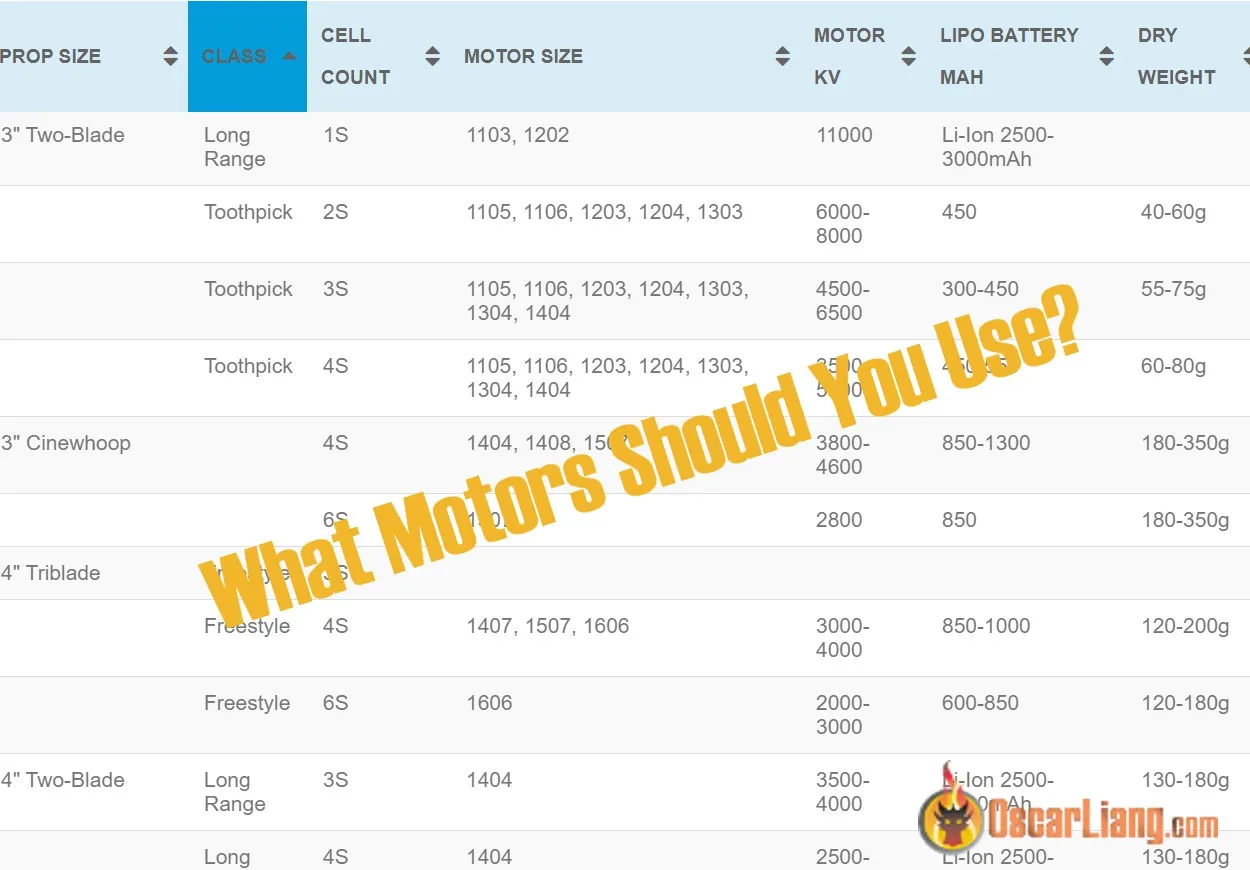
Choosing the right motor size and KV for your FPV drone can be challenging, especially when considering prop size and LiPo voltage. While there isn’t a one-size-fits-all answer, this guide provides a range of options based on my years of experience of various builds.


Looking to learn how to build an FPV drone from scratch? Check out my comprehensive tutorial here: https://oscarliang.com/how-to-build-fpv-drone/
For motor recommendations, check out my buyer’s guide: https://oscarliang.com/motors/
Table of Contents
FPV Drone Components Table
This lookup table is designed to help those building a new FPV drone who may be unsure about the ideal motor and propeller combinations. It’s important to note that this isn’t an exhaustive list, but rather a collection of popular and successful examples for different prop sizes and LiPo cell counts.
Regarding battery size — people will never 100% agree on what the optimal capacity should be, because everyone’s requirements and opinions differ. The general rule of thumb is to use a battery that’s roughly half the drone’s dry weight. If you’re willing to sacrifice some agility and power for longer flight times, it’s perfectly fine to use a slightly heavier pack. Ultimately, there’s no one-size-fits-all answer here — this is just a general guideline to help you choose.
I’ve tried to include as many examples as possible, new motor and propeller combinations are regularly being updated, but if you find something missing, please share in the comments below. Your feedback is invaluable in making this resource even better for fellow FPV drone enthusiasts.
| Prop Size | Class | Cell Count | Motor Size | Motor KV | LiPo Battery mAh | Dry Weight |
|---|---|---|---|---|---|---|
| 31mm (1.2") Triblade | Tiny whoop 65mm | 1S | 0702, 0802 | 23000-30000 | 260, 300, 450 | 16-22g |
| 31mm (1.2") Twoblade | Tiny whoop 65mm | 1S | 0702, 0802 | 30000+ | 300 | 16-22g |
| 40mm (1.6") Triblade | Tiny whoop 75mm | 1S | 0802, 1002 | 20000-23000 | 450-550 | 20-30g |
| Tiny whoop 75mm | 2S | 0802, 1002, 1102 | 12000-14000 | 450-650 | 30-50g | |
| Tiny whoop 75mm | 3S | 1102, 1103 | 8000-11000 | 300-650 | 40-70g | |
| 40mm (1.6") Twoblade | Tiny whoop 75mm | 1S | 0802, 1002 | 23000-25000 | 450-550 | 20-30g |
| Tiny whoop 75mm | 2S | 0802, 1002 | 14000+ | 450-650 | 30-50g | |
| 2" Triblade | Cinewhoop | 2S | 1003, 1103 | 11000-15000 | 450-650 | 70-90g |
| Cinewhoop | 3S | 1103, 1104, 1203, 1303 | 6000-7500 | 450-650 | 80-100g | |
| Cinewhoop | 4S | 1303, 1304 | 5000-6000 | 450-720 | 120-140g | |
| 1.6" Triblade | Ultralight | 1S | 1002 | 21000-23000 | 450-650 | 30g |
| 2" Triblade | Ultralight | 1S | 1002, 1003, 1102 | 20000-23000 | 450-650 | 30-40g |
| Ultralight | 2S | 1002, 1003, 1103 | 10000-14000 | 450-650 | 30-50g | |
| Ultralight | 3S | 1103, 1105 | 6000-8000 | 300-450 | 60-100g | |
| Ultralight | 4S | 1105, 1106 | 5000-6000 | 450-650 | 70-130g | |
| 2.5" Triblade | Ultralight | 2S | 1203, 1204, 1303 | 7500 | 450-650 | 55-70g |
| Ultralight | 3S | 1203, 1204, 1303 | 6000 | 450-650 | 120-140g | |
| Ultralight | 4S | 1404 | 4500 | 450-850 | 140-180g | |
| Cinewhoop | 4S | 1404 | 4500-5000 | 650-850 | 140-180g | |
| 2.5" Two-Blade | Ultralight | 1S | 1102, 1103 | 13000-15000 | 300-450 | 25-35g |
| Ultralight | 2S | 1203, 1204, 1303 | 7500-10000 | 450-550 | 40-60g | |
| Ultralight | 3S | 1203, 1204, 1303 | 6000-8000 | 450-550 | 45-65g | |
| Ultralight | 4S | 1303, 1404 | 4500-6000 | 450-650 | 55-90g | |
| 3" Triblade | Freestyle | 2S | 1303, 1404 | 4500-5500 | 550-650 | 70-100g |
| Freestyle | 3S | 1303, 1404, 1407 | 4000-5000 | 550-850 | 90-200g | |
| Freestyle | 4S | 1404, 1407, 1506 | 3000-4200 | 450-850 | 140-260g | |
| Freestyle | 6S | 1506, 1507 | 2700-3000 | 550-850 | 150-280g | |
| 3" Two-Blade | Long Range | 1S | 1103, 1202, 1203 | 10000-12000 | Li-Ion 2500-3000mAh | 60-80g |
| Ultralight | 1S | 1202.5, 1203, 1303 | 11000-14000 | 450 | 30-50g | |
| Ultralight | 2S | 1203, 1204, 1303 | 6000-8000 | 450 | 40-60g | |
| Ultralight | 3S | 1203, 1204, 1303, 1304 | 4500-6500 | 300-450 | 55-75g | |
| Ultralight | 4S | 1303, 1304, 1404 | 3500-5000 | 450-550 | 60-80g | |
| 3" | Cinewhoop | 4S | 1404, 2004 | 3000-4000 | 850-1300 | 180-300g |
| Cinewhoop | 6S | 1404, 2004 | 2500-3000 | 850-1300 | 180-300g | |
| 3.5" | Cinewhoop | 4S | 2004, 2006, 2106 | 2500-3500 | 1300-1500 | 250-350g |
| Cinewhoop | 6S | 2004, 2006, 2106 | 1800-2500 | 1000-1300 | 250-350g | |
| 3.5" Triblade | Freestyle | 4S | 1404, 1504, 1604, 2004 | 3500-4000 | 850-1000 | 150-200g |
| Freestyle | 6S | 1504, 1604, 2004, 2006 | 2500-3000 | 850-1000 | 150-200g | |
| 4" Triblade | Freestyle | 4S | 2004 | 2400-3000 | 850-1000 | 120-200g |
| Freestyle | 6S | 2004, 2106 | 1800-2500 | 650-850 | 120-180g | |
| 4" Two-Blade | Long Range | 3S | 1404, 1504, 1604 | 3000-4000 | Li-Ion 2500-3000mAh | 120-150g |
| Long Range | 4S | 1404, 1504, 1604 | 2500-3000 | Li-Ion 2500-3000mAh | 150-200g | |
| 5" Triblade | Freestyle | 4S | 2306, 2207, 2208, 2308 | 2300-2700 | 1300-1500 | 300-450g |
| Freestyle | 6S | 2306, 2207, 2208, 2308 | 1700-2100 | 1000-1300 | 300-450g | |
| Freestyle | 8S | 2306, 2207, 2208, 2308 | 1500-1700 | 1000-1100 | 300-450g | |
| Racing | 4S | 2306, 2207, 2208, 2308 | 2500-3000 | 1300-1500 | 250-300g | |
| Racing | 6S | 2306, 2207, 2208, 2308 | 1900-2300 | 1000-1300 | 250-300g | |
| 5" Two-Blade | Ultralight | 4S | 2004, 2204, 2205 | 2300-3000 | 850-1000 | 150-250g |
| Ultralight | 6S | 2004, 2204, 2205 | 1600-2300 | 650-850 | 150-250g | |
| 6" | Freestyle | 4S | 2207, 2208, 2308, 2407 | 2100-2500 | 1300-1800 | 300-450g |
| Freestyle | 6S | 2207, 2208, 2308, 2407 | 1500-1900 | 1000-1500 | 300-450g | |
| 7" | Freestyle | 6S | 2806, 2807, 2808, 3106 | 1200-1400 | 2200-3000 | 400-500g |
| Long Range | 4S | 2806, 2807, 2808, 3106 | 1600-1900 | Li-ion 2500-4000mAh | 350-500g | |
| Long Range | 6S | 2806, 2807, 2808, 3106 | 980-1300 | Li-ion 2500-4000mAh | 350-500g | |
| 8" | Long Range | 6S | 2808, 2810, 2814 | 900-1200 | - | - |
| 10" | Long Range | 6S | 2814, 3110, 3115, 3214 | 900 | - | - |
| Long Range | 12S | 2814, 3110, 3115, 3214 | 450 | - | - | |
| 13" | Long Range | 12S | - | 330-360 | - | - |
| 15" | Long Range | 12S | - | 250 | - | - |
Dry weight refers to the total weight of the drone without the battery. Here are the definitions of the terms used in the lookup table.
What’s a Tiny Whoop?

What’s a Freestyle FPV Drone?


What’s a Racing FPV drone?


Conclusion
I hope this lookup table has provided valuable guidance in selecting the appropriate motor size, propeller size, KV, and LiPo cell count for your next drone build. Remember that these are merely suggestions, and there’s always room for experimentation to find the perfect combination for your specific applications and flying style. Happy building and flying!
Edit History
- Mar 2021 – Table created
- Apr 2023 – Article revised
- Jan 2024 – Added more motor sizes/KV to the table
- July 2025 – Updated some motor sizes and KV in the table
35 comments
he oscar, a quick question here, i want to run 1104 7500kv motors on 2″, 3s 380mah, with dji 04 lite, i see that it falls in the bracket but i also see many people warn me that the motors will burn out.
can you give me some advise? thx in advance!
It should be fine. Obviously you should check motor temp when testing it, in the unlikely event, if motors get hot you should reduce motor outputs in Betaflight. A safe option would be to opt for a less aggressive KV like 6000-6500.
Hi, Is it fine to use a 3115 500KV with a 6S battery and 10 inch props? What would be the benefits if any? Or is it bound to fail?
I have to ask this, now that you had a Racing Drone picture with the well pronounced blue thing on the drone’s head:
What is this thing, the thing that looks like a ‘wizard hat’ on the top of a Racing drone placed at the front? Is it also some symbol and a representation of stamina, to scare other drones and demoralize the competitors’ drones before the start of a race?
Are racing drones trying to look like fast insects aggressive and wild?, or some per-historic creature from the dinosaurs time? And why the racing drones want to do that?
Is the colour or the height of these pointy-things mean anything?
I am afraid I might be overthinking it.
You are not overthinking it, just in the wrong direction :)
Racers crash frequently. Having a spike on the top helps with turtle mode (so that not all the motors/props are buried in the ground).
Hello Oscar, you never talk about 1804 motor. For 4s long range 4in and freesetyle 3.5″ t hat seems a pretty sweet spot no ? The 1804 2450kv / 3450kv from rcinpower gts v3 seems pretty good what do you think; why no mention about this size ?
Thanks for the work
hey oscar, im probably a bit late but i just got an axisflying manta 3.6 which weighs about 295g dry and i’d like to ask if a 6s 1300mah 150c lipo is too much, thats what i got recommended and i really hope you can answer
Ideally you want the battery to be around or under half the weight of the drone itself this ensures it has enough power for freestyle. But if you plan to only cruise and fly slowly, up to 1 to 1 weight ratio between the drone and battery is possible. In your case it should be okay.
Hi oscar. can you tell me what should be the ideal size of a drone that is compatible with a 350 kv motor?
Apart from propeller size, motor KV depends on battery voltage too.
Motors of this low KV, are typically used in X-class (they are massive drones) that uses 15-17 inch propellers, assuming you are using 6S or 8S battery.
Im building 4″ with 1806 2400kv 3S 1100mAh, am i cooked??
1806, 2400KV and 3S cannot go together. Those sound like a 6S setup
5.5″ props are pretty popular now. An entry for that prop size would be helpful.
I’m flying 3.6 inch with 6S 2750Kv dry weight 340g on DOGCON 1100mha(+180g) and 1380(+210g) mha.
Is the right config ? ( Speedybee V4 55A + ECS)
Sounds a bit heavy for a 3.5″ class. Mine with DJI O3 weighs around 350g including battery and that’s not the lightest setup either: https://oscarliang.com/volador-vx3-5-o3/
For 3.5″ maybe 550-650mah batteries are more suitable.
Use the Mini Stack, which could save you some weight – you don’t need that high amp rating anyway: https://oscarliang.com/speedybee-f405-mini-fc-stack/
Hi oscar I just wanted to ask what motor would be good for my build . 5inch freestyle 600 grams twin blade props 4200 mah milocel 3s battery (3*4200) . The battery itself is around 300 grams so what would u suggest
hai oscar how about 1404 motor with KV 4500 . i want to use frame diatone roma L4 and carrying runcam thumb pro with caddx nebula pro. which better using 4s lion battrey or 3s lion battrey ?
That motor KV might be too high for 4S.
Could you please include motor sizes and kv for a 4s and 6s 3.5″ cinewhoop?
Think that for Li-Ion on a 7″ Long Range you should change to 4000-8000
community need an update to this priceless resource :)
have things changed much recently? :)
do you have a 3.5 4s and 6s recommendations
This list holds immense value for those that don’t know the math to calculate what should be used. While it’s somewhat incomplete, it’s still good enough I’m coming here at least twice a month to study it to get a stronger idea of what goes with what.
Many thanks!
Thanks! Let me know if there’s any missing quad/motor size I should add.
hey oscar!
can you provide the calculative approach to select motor,propeller aand battery based on weight or thrust.
Teach me how to fpv freestyl
Hi Oscar
I would very much like to build a larger quad than those listed. Maybe 14″/15″ props for: Range/Flight Time, Stability as a camera platform, and Slower rotating props for noise/annoyance reduction.
The insane (YouTube: ‘TBS Discovery Pro on Steroids !’ being along the right lines. but very expensive. :)
Have you, or is there existing, a Motor/Prop chart for these larger Quads or any pertinent advice,
existing articles not being very comprehensive, or sometimes somewhat contradictory ?
Cheers
Multirotor this big isn’t very popular. main stream builds are below 7″.
I don’t have experience with 14″/15″ sorry.
No such thing as a 4S, 7-in freestyle?
Hi Oscar !
Just a little question : How a freestyle 6” quad (150-250g according to the lookup table) can be lighter than a freestyle 5” quad (250-450g ) ?
Tank you for your answer !
Happy flying
Cédric
sorry copy and paste error.
Hi Cedric, whilst we are correcting typos, shouldn’t we make certain to spell words correctly? (ie) “Tank you for your answer.” ☝️🤦
This is a great compilation, thanks!
Based on these, some nice trends on power-to-weight and disk loading could be set, with just a few more figures
would love to see that